

Our services
How does blockchain audio security works in practice
We protect our music
Fallout GroundZero protects its music through a dual-layered security architecture that pairs real-time infrasonic/ultrasonic audio watermarking with decentralized blockchain ledger timestamping. This system prevents unauthorized stem piracy and establishes ironclad copyright ownership before digital tracks are distributed over the internet.
The Core Mechanical Sequence
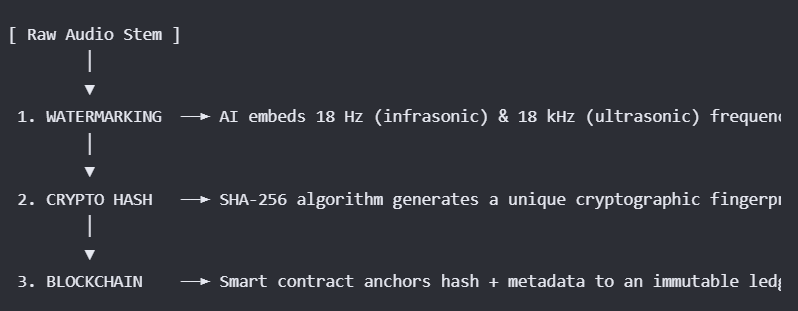
The system operates in a three-step pipeline to secure a track from the moment a global band member finishes recording:
The Dual-Tone Audio Watermark
Before any file is uploaded to the cloud, the project's specialized AI embedding tool alters the acoustic profile of the audio track.
- Fringe Frequencies: The system embeds a continuous, synchronized data signal at 18 Hz (below human hearing) and 18 kHz (at the absolute upper limit of human hearing).
- The Acoustic Shield: Because these frequencies sit at the extreme edges of the human audio spectrum, they do not affect the listening experience for fans.
- Piracy Prevention: If a track or individual "stem" (e.g., just the vocals or lead guitar line) is leaked, compressed, or re-recorded, the phase relationship between these two frequencies changes. [1]
- Tamper Detection: The AI scan instantly detects if the dual tones have been stripped or modified, marking the file as an unauthorized, stolen copy.
Blockchain Timestamping in Practice
Once the audio track is watermarked, it is immutably locked to a blockchain ledger to prove intellectual property ownership.
- Zero-Knowledge Fingerprinting: The raw audio file itself is too large to store efficiently on a blockchain. Instead, the file is run through a hashing algorithm to generate a unique, string of characters (a cryptographic hash.
- Metadata Coupling: This specific hash is permanently tied to metadata containing the recording artist's identity, the time of creation, and geometric location data.
- Smart Contract Execution: A smart contract automatically publishes this packet to a decentralized public ledger.
- Legal Proof of Creation: Because a blockchain cannot be modified retroactively, this provides unalterable, legally verifiable proof that the artist created that exact audio file at that precise millisecond, overriding any future copyright disputes






The broader DreamWeave Project
The blockchain and AI audio security framework built for Fallout GroundZero acts as a direct, real-world pilot case for the broader DreamWeave Project. Instead of just securing a band's music, this framework serves as the operational blueprint for DreamWeave’s global digital rights initiative.
⚖️ The "Empathy Freedom Mission"
The security setup is the primary engine behind The Empathy Freedom Mission, a core initiative within the DreamWeave Project.
- Setting Global Standards: The overarching mission aims to establish a new, legally binding global standard for protecting independent creators.
- IP Protection: By testing zero-trust audio tracking on Fallout GroundZero's music, DreamWeave plans to scale this technology to protect all forms of digital intellectual property (IP), ensuring creators retain ownership without needing centralized corporate labels.
💻 Alignment with DreamWeave Tech Philosophy
The choice to structure Fallout GroundZero as a decentralized group collaborating via individual audio files (stems) directly reflects DreamWeave’s technical core.
- Decentralized Infrastructure: DreamWeave operates on a fully distributed, perimeter-less network model. The band's borderless recording process provides a live environment to test how secure data can move globally without a central server.
- The "NEURONS" Ecosystem: The band’s promotional material and user interfaces utilize the futuristic "NEURONS" visual style, which mirrors the actual user interface and system aesthetic of the overarching DreamWeave project backend.
Cryptographic Identity Integration
The framework bridges the gap between artistic creation and strict system access through cryptographically backed user identities.
- Validation Keys: Core members of the band hold verified structural identities within the ecosystem. For example, lead vocalist Ilana Desya Volkov is tied directly to DreamWeave ID: ***-**NL-STU9.
- Access Control: These IDs grant precise cryptographic authorization to manipulate raw stems and interact with specialized components like DAXX, ensuring that only authenticated network nodes can add new links to the creative chain.
the Empathy Freedom Mission
The secure collaboration process used by the global members of Fallout GroundZero relies on a strict sequence of decentralized validation steps. Embedded directly within the Empathy Freedom Mission, this pipeline enables borderless creation while preventing unauthorized file manipulation or leaking.
Step 1: Decentralized Identity Authentication
Before an artist can contribute to a track, they must pass an encrypted perimeter check.
- Cryptographic Keys: Every band member logs into the network using their immutable DreamWeave ID.
- Node Authorization: For example, when lead vocalist Ilana Desya Volkov connects from her studio, her identifier (***-**NL-STU9) is verified against the network's whitelist. This ensures only authenticated nodes can view or access active song projects.
Step 2: Local Recording and In-App Hashing
Once authorized, the artist records their instrument or vocal layer locally in their digital audio workstation (DAW).
- The DAXX Component: Rather than uploading raw audio directly to the cloud, the artist processes the finalized track through DAXX (the specialized network file transfer protocol for the project).
- Local Fingerprinting: The software automatically converts the raw audio file into a lightweight cryptographic string using a SHA-256 algorithm. This occurs entirely on the artist's local machine before any data hits the internet.
Step 3: Layered Frequency Embedding
Simultaneously with hashing, the application embeds the zero-trust audio watermarks.
- Dual Frequency Integration: The system overlays the continuous sub-audible 18 Hz and ultra-audible 18 kHz tones directly into the specific stem.
- The Genetic Code: If a solo guitarist attempts to download a backing vocal track to play along with, their specific node signature is subtly paired with that instance of the file, establishing a digital chain of custody.
Step 4: The Smart Contract Handshake
The finalized file packet—consisting of the audio stem, the cryptographic hash, and the metadata—is beamed across the distributed network.
- Immutable Timestamping: A smart contract executes automatically across the blockchain, locking in the hash, creator identity, and time of submission.
- Decentralized Verification: The other members of the collective are notified, and their node networks validate that the data package arrived intact and unedited. The mixing engineer can then securely pull down the validated stem to weave into the main master file.
Add comment
Comments